Luoyang
The Romance of the Three KingdomsLuoyang is the Han capital at the center of the novel’s account of dynastic breakdown: its destruction under Dong Zhuo turns political disorder into a transformed landscape of ruined palaces, displaced inhabitants, and hunger. The city is also a point of return and passage. When the emperor comes back, he finds not a recovered seat of government but a devastated capital in which court life continues amid ruins; later, Guan Yu’s convoy travels toward Luoyang through guarded routes and confrontations. The city’s fate thus links the collapse of imperial authority to the practical dangers of movement, refuge, and rule.
Capital and historical setting
The novel places Luoyang within the end of the Han dynasty, a period when central government disintegrates and powerful leaders carve out territories from the weakening empire. Its account draws on events recorded in histories of the period, but presents them through the dramatic tradition of folk storytelling and the shaping work of a later novelist. Luoyang’s destruction is one of the defining historical calamities in that larger story: the burning of a historic capital is not merely a change of setting, but evidence that the institutions and places associated with imperial rule have become vulnerable to military power.
This role resonates beyond the novel’s immediate action. The fall of the Han and the emergence of the Three Kingdoms became, for later generations, a familiar emblem of dynastic decay and collapse. Luoyang’s ruin gives that pattern a physical form. The city that should embody a stable imperial center is instead subject to factional violence, abandonment, and the repeated need to establish authority elsewhere.
The palace crisis and destruction
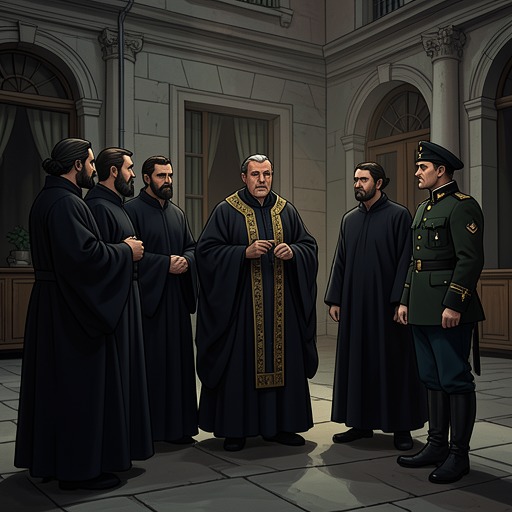
The crisis that precedes the capital’s ruin grows out of conflict at court. After Dong Zhuo is allowed to enter Luoyang, Yuan Shao and Cao Cao seek to attack the palace and eliminate the Ten Imperial Attendants. He Jin, summoned into the inner court by his sister, Empress He, enters without his allies and is killed by the eunuchs’ supporters. His death sparks a violent assault on the palace: Yuan Shao and Cao Cao break through its gates, the palace catches fire in the ensuing disorder, and the surviving eunuchs attempt unsuccessfully to use the emperor, his brother, and the empress as protection.
Zhang Rang and Duan Gui escape with the young Emperor Shao and Prince Xie. Their flight leaves the imperial household exposed and uncertain of whom to trust. The episode presents the palace not as a secure center capable of containing political conflict, but as the place where that conflict breaks into open violence and drives the rulers into flight.
Dong Zhuo’s departure completes the destruction. He orders the entire city, including its ancestral shrines and palaces, burned. Imperial tombs are broken open, and their treasures are scattered; the tombs of nobles and wealthy people are also entered and plundered. The campaign against the city extends beyond the buildings that house government: it reaches the sites and objects through which the ruling order preserves its ancestry and status.
The human consequences are equally central to the novel’s account. Five thousand troops are sent into the city to kill people associated with Yuan Shao and seize their property; thousands are murdered, including nobles, wealthy merchants, and their families. The surviving population is driven on the long march toward Chang’an, and many die along the way as soldiers rape and pillage. The destruction therefore includes both the loss of the capital’s built environment and the forced displacement of its inhabitants.
Return to a city in ruins
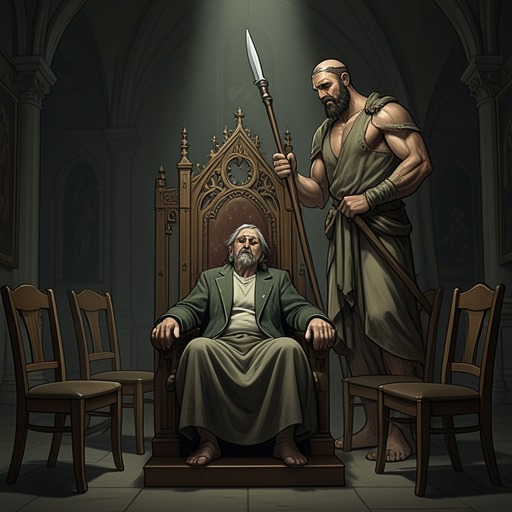
After the White Wave army scatters and the route to the old capital opens, the emperor returns to Luoyang. What he finds confirms that the journey has not restored the old seat of power. The palaces and halls have burned to the ground; weeds and brambles cover the streets and ruins; collapsed roofs and crumbling walls are all that remain of the former courts. One building is still partly intact, and the emperor lives there, while the court meets in the overgrown ruins around it.
The setting makes the weakness of imperial government visible in ordinary conditions of life. Another year of famine has left no food. The few hundred families still in Luoyang survive on bark and roots, and people die beside the remains of their homes. The emperor’s return is consequently a return to a capital in name more than in substance: court ritual continues, but the city can neither provide security nor sustain its residents.
The devastation also shapes the next decision about the emperor’s safety. Yang Biao proposes summoning Cao Cao because he commands the strongest army. With the emperor’s consent, a messenger is sent to bring him to Luoyang; Cao Cao prepares for the long journey. The ruined city thus becomes the setting in which the imperial court must seek military protection from a powerful regional leader, deepening the dependence that will define the emperor’s position.
Routes, encounters, and later political geography
Luoyang remains a destination within the novel’s network of guarded roads and territorial boundaries. During Guan Yu’s journey with a convoy, the party sets out for the city after receiving a letter from Hu Hua, whose son Hu Ban serves among Cao Cao’s troops in the area. At Dongling Pass, a commander questions the group about its destination and challenges its attempt to travel north toward Yuan Shao’s territory. Guan Yu kills the commander when he obstructs the party, pardons the soldiers, and proceeds toward Luoyang.
At the next district, Governor Han Fu learns of their progress and fears punishment if he allows a fugitive to pass without papers. He and his adviser arrange an ambush. The adviser’s attack and attempted retreat fail to draw Guan Yu into their planned trap; Han Fu’s arrow wounds Guan Yu’s arm without stopping him. Guan Yu kills both men and continues with the convoy, bandaging his arm as he rides. This episode makes the approach to Luoyang a test of passage through competing authorities: the journey’s direction exposes the travelers to local officials who assert control over roads and movement.
The city’s wider historical importance also appears in strategic and regional calculations elsewhere in the novel. Kong Ming describes Cao Cao as holding the emperor and thereby possessing the allegiance of many nobles; that political advantage is tied to the capture and control of the imperial center, even as the court’s history has already shown how fragile the capital itself can be. Later, after Cao Cao retreats from the Hanzhong campaign, Xuande’s commanders urge him to become emperor, and Kong Ming argues that his rule can answer the country’s need for a legitimate sovereign. The contrast between a ruined Han capital and renewed claims to imperial authority underscores the distinction between possessing the old center and establishing a new political order.
Narrative significance
Luoyang’s destruction and return form a stark contrast: the city is first the setting of a palace crisis, then the object of deliberate devastation, and finally the shelter of an emperor whose court meets among ruins. Its physical condition measures the distance between imperial title and effective power. When the emperor returns, the surviving fragment of one building cannot restore the palaces, the people, or the security that the capital once represented.
The novel’s account also connects political upheaval to the lives of people largely absent from official histories. The destruction is narrated through the killing of families, forced migration, hunger, and death among the remaining households, rather than solely as a contest among leaders. Luoyang is therefore both a symbol of dynastic collapse and a place where that collapse is experienced as loss of home, food, and protection. Its ruined streets remain a practical landscape through which characters travel, but also a persistent reminder that military possession of the capital does not by itself repair the state.